
Reach
The number of unique accounts or people shown the content under a platform's current measurement rules.
- Describes distribution breadth
- Can come from followers or discovery
- Does not prove attention
 Login
Login
 Register
 Blog
Blog

Reach describes exposure. Engagement describes response. Neither metric explains content performance alone, so the useful question is how they relate to the audience, format, timing, and objective.
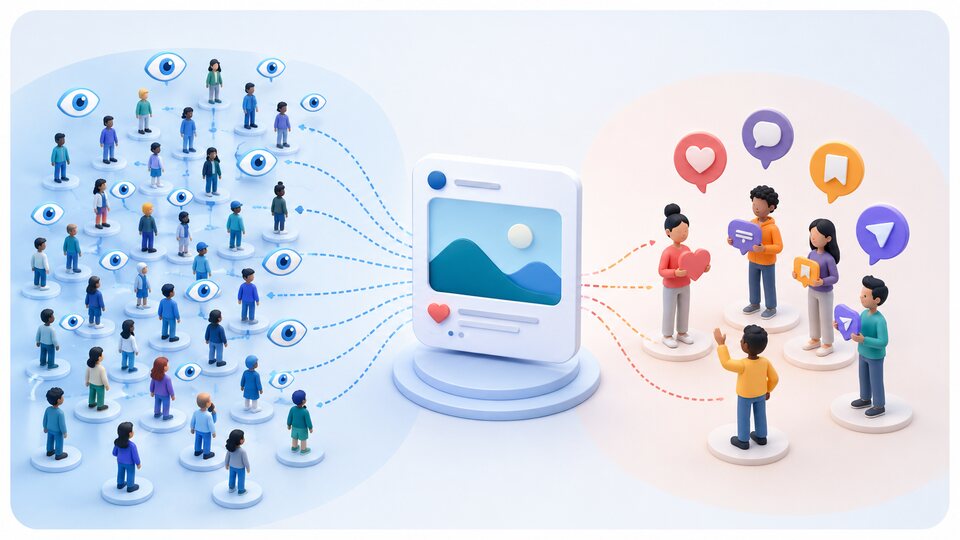
The number of unique accounts or people shown the content under a platform's current measurement rules.
Actions or behaviors around the content: likes, comments, saves, shares, clicks, profile actions, or viewing depth.
For the full signal map, start with Engagement Signals Explained.
Use patterns as diagnostic prompts, not automatic verdicts.
Distribution and response are both strong. Check retention and downstream actions before scaling.
The content was exposed broadly but the audience, hook, format, or promise may not have matched.
A smaller audience responded well. Test whether the result remains useful with broader distribution.
There is not enough evidence for one conclusion. Review distribution, presentation, topic fit, and timing.
The formula becomes useful only after you define which actions count, use the same method across comparable posts, and account for format and time period. A short video, photo, livestream, and profile post should not automatically share one benchmark.
If reach exists but response stays weak, continue to Why Content Underperforms Even With Followers. If the audience itself may be mismatched, read Why Follower Quality Matters.
Reach describes how many unique accounts or people were exposed under platform rules. Engagement describes actions or behaviors around that content.
Yes. Broad distribution can expose content without producing a strong response when audience, message, presentation, or timing does not fit.
No. Interpret it with reach, retention, traffic source, profile actions, conversions, and the creator's actual objective.
You can also purchase promotion directly and start gaining followers and likes immediately, without registration.